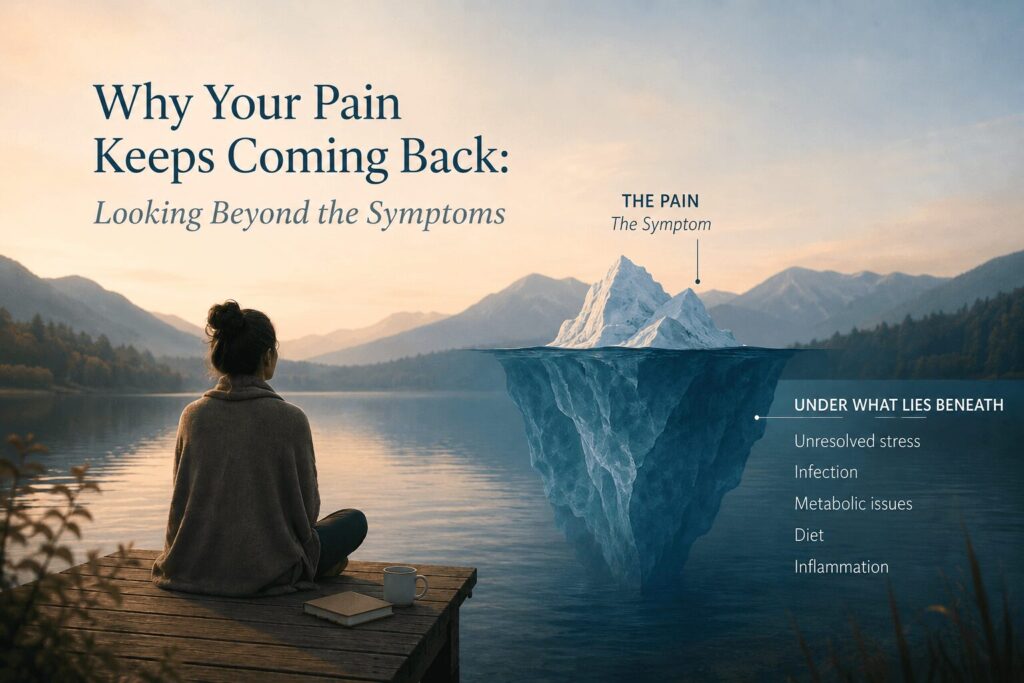
You’ve had the massage. You’ve done the stretches. Maybe you’ve even had steroid injections or a course of manual therapy. The pain eases for a while — and then, weeks or months later, it’s back. Sound familiar?
If pain keeps returning to the same area, or keeps shifting from one part of your body to another, it’s usually not because the original treatment “didn’t work.” It’s because treatment addressed the symptom — the sore muscle, the stiff joint, the inflamed tendon — without addressing why that area became vulnerable in the first place.
Pain Is Local. The Cause Often Isn’t.
Osteopathy has always understood the body as a connected system: tension or restriction in one area changes how load is distributed everywhere else. For example a stiff hip changes how you walk, which changes how your lower back works, which eventually shows up as pain somewhere else entirely.
Functional medicine adds another layer to that picture — because your body’s internal environment (inflammation levels, circulation, gut health, stress hormones, sleep quality) directly affects how well tissues heal, and how sensitive your nervous system is to pain in the first place.
Put simply: structure affects function, and function affects structure. Treating one without considering the other is often why pain relief doesn’t last.
Common Reasons Pain Keeps Returning
- The Underlying Mechanical Pattern Was Never Corrected
Pain often shows up at the site that’s compensating hardest — not necessarily the site that’s actually dysfunctional. Repeated treatment to the painful area alone, without addressing posture, movement patterns, or restrictions elsewhere in the body, tends to bring only temporary relief.
- Ongoing Low-Grade Inflammation
Inflammation is a normal, necessary part of healing — but when it doesn’t fully resolve, tissue stays sensitised and prone to flaring with minimal provocation. Diet, gut health, poor sleep, and chronic stress can all keep the body’s baseline inflammation higher than it should be, making any injured area slower to settle and quicker to reignite.
- Poor Circulation and Fluid Drainage
Healing tissue depends on a steady supply of oxygen and nutrients, and on efficient removal of waste products and inflammatory byproducts. Restricted, tense, or poorly mobile tissue (from prolonged sitting, old injuries,scars or fascial tightness) can quietly impair this exchange, leaving an area less able to fully recover between flare-ups — even when it “looks fine” on a scan.
- A Nervous System on High Alert
Chronic stress keeps the nervous system in a heightened state, which can lower your pain threshold and increase muscular guarding and tension — often without you consciously noticing. This is one reason pain can flare during stressful periods even without a new injury.
- Gut and Liver Load
Digestive health has a bigger influence on musculoskeletal pain than most people expect. A gut that isn’t absorbing nutrients well, or a liver that’s under extra strain, can affect the building blocks your body needs for tissue repair and its ability to regulate inflammation.
- Hidden infections
This is a growing health issue, and in my clinic, I see very often patients who have underlying chronic intra and extra cellular infections, which are hard to diagnose with common blood test. Untreated infections represent a chronic immunological challenge for the body that can eventually lead, also, to chronic pain.
- Dental occlusion and hidden dental infections
This is another very common and often undiagnosed health challenge. Malocclusion and infection , usually beneath root canal treated teeth or wisdom teeth, are causes of chronic pain.
My Combined Approach
This is where combining osteopathy and functional medicine becomes a powerful diagnostic and treatment modality that, get to the root of chronic and sometimes “mysterious” pain patterns.
- Osteopathic assessment and treatment to identify the mechanical and visceral patterns, restrictions, and compensations that are really driving your symptoms — not just treating where it hurts
- Functional medicine assessment, where relevant, to look at inflammation, gut health, nutrient status, toxicity, immunological regulation and stress load that may be keeping tissue from fully recovering
- Practical lifestyle strategies and interventions — nutrition, sleep, rebalancing of the neuro, endocrine and immune system, stress regulation etc.. — that support the body’s own capacity to heal
- A whole-body view, so that treatment isn’t just chasing the pain around your body, but addressing the conditions that allow it to keep returning
Ready to Understand What’s Really Driving Your Pain?
If you’re tired of pain that keeps coming back no matter what you try, let’s look beyond the symptom together — and get to what’s actually keeping it there.
 Receive for free the e-book I have specifically written for you, to help you learn more about the uniqueness and preciousness of your body and start a new journey of greater health and happiness. Your email is not shared with third parties and stored a GDPR compliant service provider (AWeber).